Erik Caseres - Coldwell Banker Commercial CBS

Why I Bought Real Estate When I Had No Job and Rates Were at 9%
This article challenges the idea of perfect market timing and explains why most success comes from simply getting in the game.
BIG SKY BIZ JOURNAL
Erik Caseres
1/26/20264 min read


On paper, it was a terrible time to buy real estate.
I had just walked away from a nearly 20-year career in the petroleum industry. I didn’t yet have my real estate license. There was no steady paycheck, no clear roadmap, and no guarantee that the next chapter would work out the way I hoped it would.
At the same time, interest rates had moved quickly—from historic lows into the mid 9% range. Cash flow was harder to find. Capital felt more precious. And uncertainty wasn’t theoretical—it was personal.
Most people would call that a reason to wait.
I didn’t feel confident.
I didn’t feel certain.
I just made a decision.
What People Say They’re Waiting For and What They're Really Waiting On
When people tell me they’re waiting, the reasons usually sound logical:
“Let’s see where rates settle.”
“The market feels unstable.”
“I want a little more clarity.”
But clarity is rarely the real issue.
More often, people are waiting for emotional certainty—the kind that removes the risk of regret. They want to know they’ll never have to explain the decision if something goes sideways.
Commercial real estate doesn’t work that way.
There’s no moment where uncertainty disappears.
There’s just a point where you decide whether waiting is actually helping—or quietly costing you.
The Problem With Trying to Time the Market
Every cycle produces a few stories that sound almost legendary.
Someone bought at the bottom.
Someone sold at the peak.
Someone “saw it coming.”
What those stories usually leave out is the most important detail:
They were already in the game.
You can’t time a market you never enter.
Yes, some people get lucky.
Yes, some decisions age exceptionally well.
But most perceived market-timing success comes from participation, not prediction. The people who “timed it right” didn’t have better foresight—they made a decision, got positioned, and stayed long enough for the fundamentals to work.
From the outside, that looks like timing.
From the inside, it feels a lot more like endurance.
Why I Bought Anyway
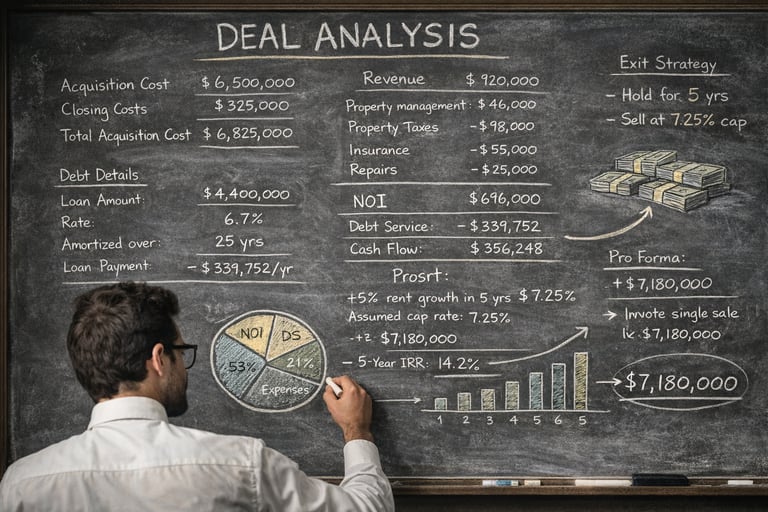
The property I bought during that transition is still one of the best cash-flowing assets in my portfolio.
At the time, it didn’t feel bold—it felt heavy. Using savings while changing careers is uncomfortable. Taking on debt when rates are high doesn’t inspire confidence (although, through creative financing I ended up with a stellar rate on this property!). And doing both at once will test your stomach.
What made the difference wasn’t optimism. It was discipline.
Instead of waiting for the market to feel safe, I focused on what I could control:
Buying at a solid basis
Structuring the deal creatively to reduce downside risk
Stress-testing the numbers under conservative assumptions
The deal wasn’t perfect. But it was resilient.
And something unexpected happened—it reduced uncertainty instead of adding to it. The asset created stability while everything else felt in motion. It (along with my other cash flowing assets) gave me margin to transition into a new career without needing immediate perfection.
I still own the property today. It continues to perform. And while some might say the timing worked out well, the reality is simpler:
I chose to get in (or perhaps, double down on) the game.
CRE Is a Buy-and-Hold Business
Commercial real estate isn’t a short-term trade. It’s not built for perfect entry points or precise predictions.
It rewards:
Long time horizons
Conservative assumptions
The ability to hold through discomfort
When you view CRE as a buy-and-hold business, timing becomes less important than structure. The question shifts from “Is this the perfect moment?” to “Can this deal survive if things don’t go exactly as planned?”
If it can, time becomes an ally.
How Risk Is Actually Managed
Risk isn’t minimized by waiting for certainty.
It’s managed through fundamentals.
Experienced operators focus on:
Basis – buying with margin for error
Debt – payments that work even under stress
Cash flow – realistic, not best-case assumptions
Flexibility – multiple paths forward if conditions change
These aren’t flashy strategies. But they work in uncertain markets because they’re built for them.
Buyers, Sellers, and the Same Fear
Buyers wait because they’re afraid of overpaying.
Sellers wait because they’re afraid of leaving money on the table.
Different positions. Same hesitation.
Both are trying to avoid regret.
But in real estate, regret usually doesn’t come from acting imperfectly—it comes from watching opportunity compound without you.
Final Thought
The Bottom line: there will always be a reason to wait.
Rates.
Markets.
Headlines.
(Oh, the headlines...Please ignore the headlines. They are a terrible decision-making tool.)
If you need certainty before you move, you’ll be waiting forever.
The people who build lasting wealth in commercial real estate aren’t perfect timers. They’re consistent participants who manage risk, extend their horizon, and make decisions without guarantees.
Sometimes the biggest risk isn’t getting in too early—it’s never getting in at all.
If you’re sitting in a “wait and see” moment—whether you’re considering buying, selling, or trying to figure out your next move—it may help to talk it through with someone who’s navigated uncertainty firsthand.
Not to predict the market.
Not to force a decision.
Just to pressure-test the fundamentals and the structure.
If that would be useful, feel free to reach out. I’m always open to a thoughtful conversation.












Expertise
Specializing in business brokerage services & commercial real estate transactions.
Contact
Inquire
erik@cbcmontana.com
© 2024. All rights reserved.